
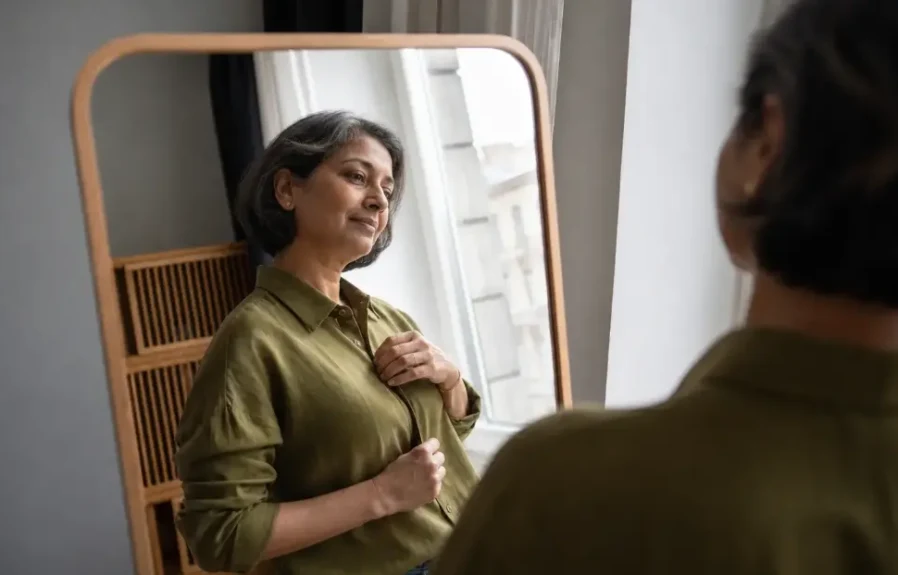
Midlife identity changes can happen as menopause, body changes, empty-nest life, career shifts, and changing relationships reshape how women see themselves. Feeling different does not mean you are losing yourself. It can be an opportunity to rebuild confidence, redefine your priorities, and discover a new version of yourself.
MidEdu.com
Midlife identity changes can be surprisingly emotional. One day, you may look in the mirror and wonder, “When did I become this person?” Changes related to menopause, body image, relationships, children leaving home, work, and aging can make you feel disconnected from the woman you once knew. But you may not be losing yourself—you may simply be changing. Midlife can be a powerful opportunity to understand who you are now, rebuild your confidence, and create a life that reflects what truly matters to you.
Table of Contents
There was a morning when I stood in front of my bedroom mirror for several minutes and barely recognized the woman looking back at me.
It wasn’t because I suddenly looked dramatically older. It was something harder to explain.
My face looked tired. My waist was thicker than it used to be. My favorite jeans no longer fit the way they once did. There were more lines around my eyes, and my hair seemed thinner and drier.
I remember thinking, When did this happen?
I’m 54 years old, and for the first time in my life, I started wondering where the woman I used to be had gone.
When Your Body Starts Feeling Unfamiliar
I had expected some changes with menopause. Hot flashes, disrupted sleep, mood changes—I had heard other women talk about them.
What surprised me was how deeply the physical changes affected my confidence.
I could eat roughly the same meals and still gain weight around my stomach. Clothes that looked great a few years ago suddenly felt uncomfortable. I stopped enjoying shopping because I didn’t like seeing different sizes on the labels.
Even getting dressed for dinner with my husband became strangely emotional.
I would stand in front of my closet thinking, Nothing looks good on me anymore.
Looking back, I realize I wasn’t really angry at my clothes.
I was grieving the version of myself I thought I had lost.
Menopause Changed More Than My Body
For a long time, I thought menopause was mostly about physical symptoms.
I was wrong.
Midlife can affect how we think about ourselves, our relationships, our priorities, and even our identity.
My children were growing up and becoming independent. My youngest had recently moved out, and our house suddenly felt much quieter.
For years, so much of my identity had been connected to being a wife and mother.
Then one day, I had more empty hours than I knew what to do with.
Instead of feeling free, I initially felt lost.
Who was I when nobody needed me to prepare dinner, solve a school problem, or drive somewhere?
That question frightened me more than any gray hair ever could.
I Started Comparing Myself to Younger Women
Another thing I didn’t expect was how often I would compare myself to younger women.
At work, I noticed women in their 30s with effortless-looking skin, fashionable clothes, and seemingly endless energy.
Social media made it even worse.
I’d scroll through photographs of women who looked beautiful, successful, fit, and completely confident.
Then I’d look at myself and think, I used to look like that.
But eventually I realized something important.
I was comparing my real life to carefully selected moments from someone else’s life.
And I was comparing my 54-year-old body to bodies that were decades younger.
That wasn’t motivation.
It was punishment.
The Moment I Realized I Wasn’t Broken
My perspective started changing after a conversation with an old friend.
We were having coffee one afternoon, and I told her I felt like I didn’t recognize myself anymore.
She looked at me and said something I’ll never forget:
“Maybe you’re not supposed to recognize the old you.”
At first, I didn’t understand.
Then she explained that we spend much of our lives becoming someone—student, wife, mother, employee, caregiver—and eventually those roles change.
That doesn’t mean we’re disappearing.
It means we’re becoming someone new.
That idea stayed with me.
Maybe I wasn’t losing myself.
Maybe I was meeting a different version of myself for the first time.
Learning to Treat My Body Differently
I also stopped trying to “get my old body back.”
Instead, I started asking a different question:
What can I do to feel good in the body I have today?
I began walking more regularly. I added some strength training. I paid more attention to sleep instead of staying up late watching television.
I started buying clothes that fit my current body rather than keeping a closet full of clothes I hoped to fit into again someday.
That small change made a surprising difference.
I also stopped weighing myself every morning.
My goal wasn’t to become 30 again.
My goal was to feel strong, comfortable, and present at 54.
That felt much more realistic—and much kinder.
I Started Rediscovering the Woman Behind the Roles
With my children grown, I finally had time to ask myself questions I had postponed for years.
What do I actually enjoy?
What have I always wanted to learn?
What kind of friendships do I want now?
What would I do if I wasn’t worried about what other people thought?
Some of the answers surprised me.
I discovered that I wanted to learn new things simply because they interested me. I wanted to travel differently. I wanted deeper friendships rather than dozens of casual acquaintances.
I even started taking a class I had been putting off for years.
It wasn’t a dramatic transformation.
There was no single morning when I suddenly became confident again.
It happened gradually.
One small decision at a time.
Maybe Midlife Isn’t About Going Back
I think many women spend too much time trying to return to who they were.
We want the old body.
The old energy.
The old face.
The old marriage.
The old family routine.
The old confidence.
But maybe that’s not the goal.
Maybe the goal is to build a life that fits who we are now.
Menopause and midlife can bring uncomfortable changes, but they can also create space.
Space to reconsider our priorities.
Space to take better care of ourselves.
Space to develop interests that aren’t connected to our children or careers.
Space to decide what actually matters.
And perhaps most importantly, space to stop apologizing for getting older.
I Still Have Days When I Don’t Recognize Myself
I’m not going to pretend I’ve completely figured this out.
There are still mornings when I look in the mirror and notice another gray hair.
There are still photographs I don’t particularly like.
There are still days when I feel tired, insecure, or nostalgic for the woman I used to be.
But I don’t automatically see those things as evidence that something is wrong with me anymore.
I’m learning to see them as reminders that I’m changing.
And change doesn’t have to mean loss.
Sometimes it means growth.
Sometimes it means letting go of an old identity so there’s room for a new one.
You May Not Be Losing Yourself
If you’re in your 40s, 50s, or 60s and you’ve recently thought, I don’t recognize myself anymore, please know that you’re not necessarily alone.
Your body may be changing.
Your children may be leaving home.
Your marriage may be entering a different chapter.
Your career may no longer feel as important as it once did.
Your friendships may change.
Your priorities may change.
And you may change, too.
That doesn’t mean the woman you were has disappeared.
She brought you here.
But you don’t have to spend the rest of your life trying to become her again.
Maybe there is another version of you waiting to be discovered.
A little wiser.
A little stronger.
A little less concerned about pleasing everyone.
And perhaps much more willing to ask:
What do I want for the next chapter of my life?
I’m beginning to believe that this isn’t the end of who we are.
It’s an invitation to become someone we haven’t met yet.
And maybe that’s something to look forward to.
Why do I feel like I don’t recognize myself during midlife?
Midlife identity changes can make you feel disconnected from your former self. Menopause, changing relationships, children leaving home, career changes, and shifting priorities can all affect your identity and self-esteem. Feeling different does not necessarily mean you are losing yourself.
Can menopause affect self-esteem and body image?
Yes. Menopause and self-esteem can be closely connected because hormonal and physical changes may affect weight, skin, sleep, energy, and mood. Body image after menopause can also become a source of insecurity, especially when your body looks or feels different from before.
How can women over 50 rebuild their confidence?
Women over 50 can rebuild confidence by focusing less on returning to their younger selves and more on feeling strong, comfortable, and fulfilled today. Regular movement, meaningful friendships, new interests, healthy routines, and realistic expectations can support a healthier sense of self.
Is feeling lost in your 50s a normal part of midlife?
Feeling uncertain or lost can be part of midlife identity changes. Major life transitions, including menopause, an empty nest, changing marriage dynamics, retirement planning, or caring for aging parents, can encourage women to reconsider who they are and what they want next.
How can I accept my body after menopause?
Accepting body image after menopause does not mean you have to love every change. It can mean learning to treat your body with patience and respect instead of constantly comparing yourself with your younger self. Focusing on strength, comfort, health, and confidence can make this transition easier.


 and then